
Understanding Real Estate Stats
Which Real Estate Market Stats Actually Matter - And What They Mean
by John Merrill & Larry Osmond
May 9, 2026
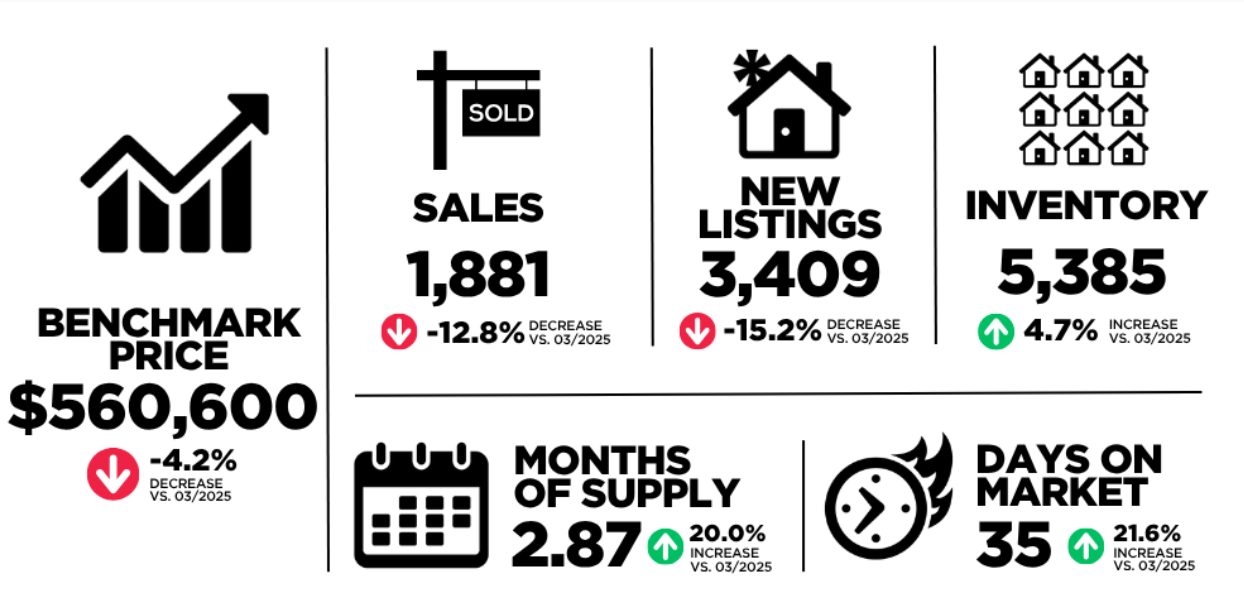
If you’ve ever looked at a real estate market report, you’ve probably seen a flood of numbers: average sale price, median price, days on market, months of inventory, and many more.
The challenge is that many people see the stats without fully understanding what they’re actually telling us – or how one number can paint a completely different picture from another.
Here’s a breakdown of the key market statistics buyers and sellers should pay attention to, and what those numbers really mean.
________________________________________________________________________________________
Average Sale Price vs. Median Sale Price
These are two of the most commonly quoted statistics – and, perhaps surprisingly, also two of the most misunderstood.
Average Sale Price
The average sale price is calculated by adding together all sale prices and dividing by the number of homes sold.
For example:
- 4 homes sell for $750,000
- 1 luxury home sells for $2,500,000
- The average sale price becomes: $1,100,000
So even though most homes sold $750,000, the average jumps to $1,100,000 because of one much more expensive sale.
Median Sale Price
The median sale price is the middle number when all sales are arranged from lowest to highest.
Using the same example:
- $750,000
- $750,000
- $750,000
- $750,000
- $2,500,000
The median price is simply: $750,000
More often than not, the median sale price provides a more realistic picture of what a “typical” home is selling for.
Why the Difference Matters
In markets with a lot of luxury sales – or very few overall sales – the average price can easily become skewed.
That’s why many analysts and economists prefer median price when measuring broader market trends. However, this isn’t to suggest that one should be ignored in favour of the other – looking at both together often gives a clearer picture – especially in case-by-case analyses such as comparative market assessments of specific properties.
________________________________________________________________________________________
Days on Market (DOM)
This measures how long it takes for homes to sell.
Low Days on Market
- Indicates strong demand
- Buyers are acting quickly
- Sellers typically have more leverage
High Days on Market
- Indicates slower demand
- Buyers may have more negotiating power
- Pricing becomes increasingly important
However, context matters.
A properly priced home in a slower market may still sell quickly, while overpriced homes can inflate the average DOM statistic.
Further, it is not uncommon for listings of properties that have been sitting on market for a while to be canceled and relisted, which can skew the perception of how many days the property has actually been on market. Some real estate boards will still capture the days on market of previous listings and show a Cumulative Days on Market (CDOM) tally. This is ideal because it provides a more accurate representation of days on market. But, how different real estate boards calculate this varies. For example, some require a minimum number of days off market before the previous days on market are no longer counted, but there isn’t consistency from one real estate board to another. Your Realtor will be able to share the full listing history of any listing you may be interested in.
________________________________________________________________________________________
Months of Inventory (MOI)
This is one of the most important indicators of whether the market favours buyers or sellers, yet it’s also one of the most overlooked stats by buyers and sellers. It measures how long it would take to sell all current listings if no new homes came onto the market.
The formula is: Total Number of Active Listings / Number of Sales in Previous Month
General Guidelines
| Months of Inventory | Market Type | Meaning |
| 0-2 months | Strong Seller's Market | Expect competition; prices likely rising |
| 2-3 months | Mild Seller's Market | Still competitive but stabilizing |
| 3-5 months | Balanced Market | Fair for both buyers and sellers |
| 5-6 months | Mild Buyer's Market | More negotiating power for buyers |
| 6+ months | Strong Buyer's Market | Buyers have significant leverage |
For example:
- 640 active listings
- 200 sales last month
Results in: 640 / 200 = 3.2 Months of Inventory
That would suggest a relatively balanced market.
The reason MOI is so noteworthy is because home prices are often a lagging indicator and can change slowly over a period of several months. Further, you often want to see several months or more of price data to get a sense for pricing trends. This is good information, but it doesn’t give you a real-time look at how the market may be changing.
MOI, on the other hand, shifts quickly. When inventory tightens or swells, MOI reacts almost immediately, giving you an early signal of:
- Upcoming price increases (when inventory is low)
- Possible price softening (when inventory rises)
Not only does MOI give you that finger-on-the-pulse sense of what’s happening in the market in real-time, it’s your early-warning system if you want a preview of where the market may be headed.
________________________________________________________________________________________
Sales-to-New-Listings Ratio (SNLR)
Similar to Months of Inventory, the Sales-to-New-Listings Ratio measures momentum as it happens. It compares how many homes sold versus how many new listings hit the market. In other words, it tells you the pace at which the market is moving.
The formula: (Total Sales in a Period / Total New Listings in a Period) x 100%
What It Means
- Above 60%: Seller’s market
- 40-60%: Balanced market
- Below 40%: Buyer’s market
A market can still have low inventory overall but begin softening if new listings suddenly outpace sales.
________________________________________________________________________________________
Number of Sales
This statistic often gets overlooked, but it tells us a lot about market confidence. After all, it is possible that prices remain relatively stable for a period even while sales activity drops sharply.
When transaction volume declines:
- buyers may be hesitant,
- sellers may delay listing,
- financing conditions may tighten,
- or uncertainty may increase.
Watching sales volume alongside prices provides a more complete understanding of market health.
________________________________________________________________________________________
Active Listings
This measures how many homes are currently available for sale.
Rising inventory generally gives buyers:
- more choice,
- more negotiating power,
- and less urgency.
Falling inventory tends to increase competition and upward pressure on prices.
But inventory alone never tells the full story. A city with 1,000 listings may still be extremely competitive if sales activity is high enough.
________________________________________________________________________________________
Sale-Price-to-List-Price Ratio
This shows how close homes are selling to their asking prices.
Examples:
- 102% ratio → homes selling over asking
- 98% ratio → homes selling below asking
This statistic can help reveal market psychology.
In hot markets, aggressive bidding tends to push this number above 100%, while in slower markets, buyers may gain some negotiating leverage.
________________________________________________________________________________________
Why One Statistic Alone Can Be Misleading
No single market statistic tells the whole story.
For example:
- Average prices could rise simply because more higher priced homes sold.
- Sales could decline while prices remain stable.
- Inventory could increase but still remain historically low.
- Days on market could rise because sellers are overpricing homes.
That’s why it’s so important to look at multiple data points together rather than focusing on one headline number.
________________________________________________________________________________________
The Bottom Line
Real estate statistics are valuable tools – but only when properly understood in context.
The most informed buyers and sellers look beyond headlines and focus on the relationships between the numbers:
- prices,
- inventory,
- sales activity,
- and market balance.
Understanding what these statistics actually mean can help you make smarter decisions, negotiate more effectively, and better understand where the market may be heading next.
Get in Touch
As your trusted resource for all things real estate, I’d be more than happy to provide you with additional insight on how to best prepare for buying or selling real estate in any market. If you have questions about the market, please reach out anytime.
Want a better real estate experience? Let’s chat.
CENTURY 21 Miller Real Estate Ltd. Brokerage
INFO & SERVICES
CENTURY 21 Miller Real Estate Ltd. Brokerage
209 Speers Road, Unit 9, Oakville, ON L6K0H5
(905) 845-9180
INFO & SERVICES

John Merrill is an experienced Hamilton Realtor with over 10 years experience with Oakville, Hamilton, Guelph and Burlington real estate. As a five-time CENTURY 21 Centurion Award winner, he is recognized as being one of the top Realtors in the CENTURY 21 network and consistently delivers expert negotiations, high-level performance, and a deep understanding of the Burlington and Hamilton real estate markets. His knowledge of home construction, combined with a strong community focus, gives clients a strategic advantage when buying or selling.
Independently Owned and Operated. ®/™ trademarks owned by Century 21 Real Estate LLC used under license or authorized sub-license. © 2020 Century 21 Canada Limited Partnership © 2020 Century 21 Canada Limited Partnership
The trademarks MLS®, Multiple Listing Service® and the associated logos identify professional services rendered by REALTOR® members of CREA to effect the purchase, sale and lease of real estate as part of a cooperative selling system. The trademarks REALTOR ® , REALTORS ® and the REALTOR ® logo are controlled by The Canadian Real Estate Association (CREA) and identify real estate professionals who are members of CREA. Used under license. This listing content provided by REALTOR.ca has been licensed by REALTOR® members of The Canadian Real Estate Association. Not intended to solicit properties currently listed for sale or buyers under contract.
Century 21 Canada Limited Partnership currently has franchise opportunities available in select markets across Canada. The intent of this communication is for informational purposes only and is not intended to be a solicitation to anyone under contract with another real estate brokerage operation. This e-mail message contains confidential information intended only for the use of the individual or entity named above. Any unauthorized use or disclosure is strictly prohibited. If you have received this communication in error please immediately delete the e-mail and either notify the sender at the above e-mail address or by telephone.
© 2026 MoxiWorks
